


AI has become an integral part of everyday software testing.
Artificial intelligence and software testing today – what do the results of our comprehensive survey conducted at HUSTEF reveal?
At the HUSTEF 2025 conference, more than 220 IT professionals took part in a survey conducted by Masterfield, exploring the current relationship between AI and software testing. The responses offer insights into how artificial intelligence is shaping testers’ day-to-day work, the opportunities and challenges it brings, and the extent to which professionals actually worry about it. Explore the survey results:

AI Has Entered the Testing World – and It’s No Longer Just Visiting
The results are clear: AI is no longer a future promise—it’s already part of testers’ everyday work. But how do professionals view it: with fear, or with curiosity and enthusiasm? The answers strongly point to the latter.
A New Ally for Testers
More than half of respondents—51.1%—already use AI in their work on a daily or weekly basis. This is a major shift compared to just a few years ago, when it was seen mostly as an experimental tool. Many describe it as a digital teammate that never gets tired and is almost always available for quick analysis, code review, or test data generation.
"AI doesn’t work instead of me; it works alongside me," as one respondent aptly put it. Of course, some still don’t use these tools regularly (around 11.89%), but most agree it’s only a matter of time.
Where Does AI Help the Most?
Testers say AI delivers the greatest value in creative, time-consuming, or repetitive tasks. Most often, they use it for test planning and test case creation (53.74%), test automation (51.98%), and data generation or requirements analysis (around 26.84%). This suggests AI isn’t taking over a single area; it shows up wherever repeatable patterns and decisions occur—exactly where structured thinking matters most.
A Growing Appetite for Knowledge – Testers Ready for AI
According to the survey, testers see it as essential to keep up with AI developments. In fact, a significant share (41.85%) consider it one of the most important areas to focus on in the coming years. Only a small minority—just a few percent—feel that AI is irrelevant to their work. This indicates that the profession isn’t afraid of AI; instead, it’s eager to learn how to apply it effectively.
"AI is now where automated testing was a few years ago. At first, few people dared to try it; today, it’s indispensable," wrote another respondent.

AI Is Everywhere, but Not Everyone Trusts It Yet
Although most testers have already tried AI, trust hasn’t fully followed. According to the survey, 63.96% of respondents cited limited confidence in the outputs as the biggest barrier. Many worry that generated code or recommendations may not always be accurate and could introduce defects without proper human review. In addition, immature tooling (33.33%) and a lack of knowledge within teams (32.88%) also slow broader adoption. In other words, the technology is moving fast, but people still need the skills to use it effectively.
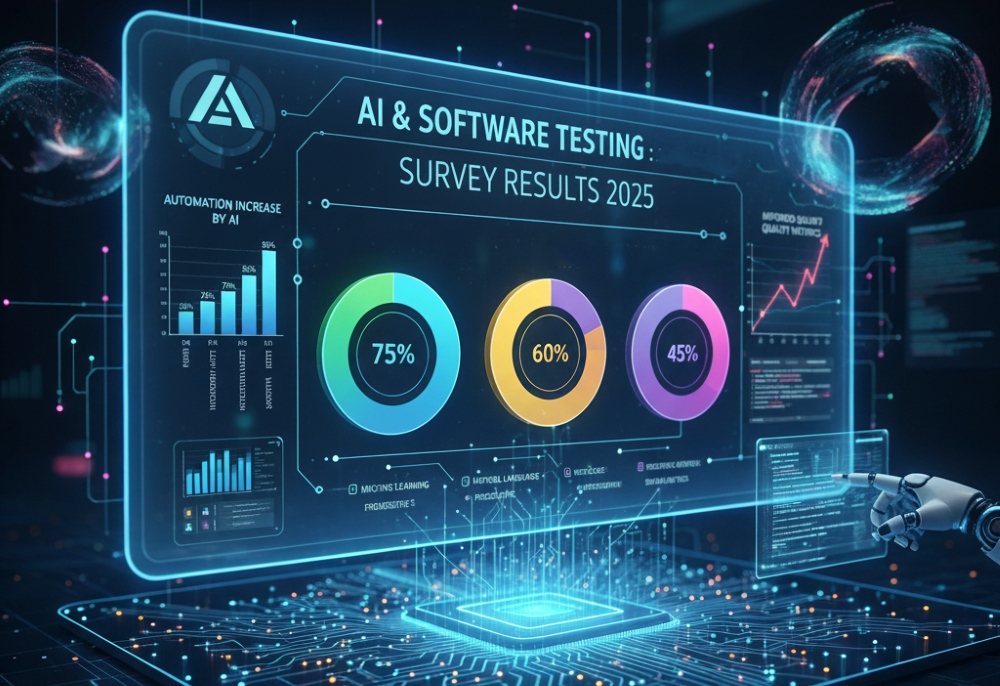
Looking for more practical takeaways? Explore the infographic from our survey:
Threat or Opportunity?
Perhaps the most compelling question—and the responses from HUSTEF are reassuring. Nearly half of testers believe AI is not a threat, but a new tool they need to learn to use. About one-third think AI will impact junior testers the most, as it can automate many entry-level tasks. Overall, most are optimistic: they see AI not as a job taker, but as something that elevates the profession.
As one respondent put it:
"AI doesn’t replace thinking; it just makes it faster and more efficient."
The Future of Testing: Humans and Machines, Hand in Hand
The HUSTEF 2025 survey makes one thing clear: AI is here to stay. It won’t replace testing—it will reshape it. AI will support testers in generating test data, detecting issues earlier, creating reports, and performing analyses. The coming years will be about learning how to collaborate with these tools in a practical, responsible way. Those who start now will gain a competitive advantage—because AI is not an enemy, but a reliable new colleague for testers.
Learn with Masterfield and strengthen your practical AI skills in our courses.