








IREB® CPRE Practitioner Requirements Modeling course
Course code:
IREB® CPRE Practitioner Requirements Modeling course - Dates and application
Applying for closed-group training
Enrolment without a date
Master the art of Requirements Modeling with international standards and best practices.
This program is recommended for you if you are involved in Requirements Engineering and Management and wish to delve further in Modeling of Requirements.
This program is intended for:
- Requirement Engineers, Business Analysts, Information Analysts and Functional Designers who want to obtain the internationally recognized IREB “Certificated Professional for Requirements Engineering – Advanced Level, Modeling” certification as part of their career
- Architects, Developers, Designers and Users involved in specifying information systems or software products
- Quality Officers and Project Managers who want to explore Requirement Engineering and Management
Candidates for the CPRE Advanced Level module examination must already have received the CPRE Foundation Level certification.
Become a certified professional in Requirements Engineering and Management
The International Requirements Engineering Board (IREB) is a leading nonprofit enterprise that aims to advance the Requirements discipline. IREB has established a Certification Program for Requirements Engineering (CPRE), which is recognized worldwide. The exams are administered by the International Software Quality Institute (iSQI).
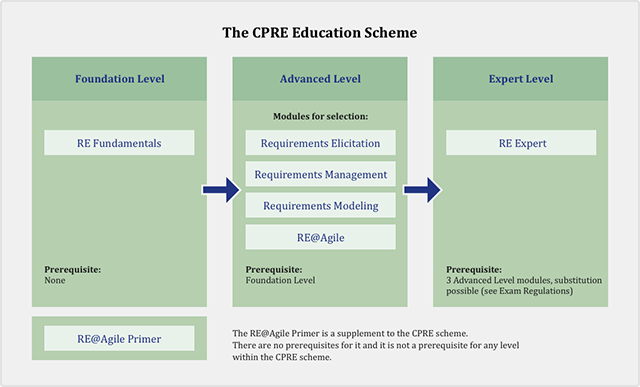
The program consists of three levels:
- Foundation Level
- Advanced Level
- Practitioner Certificate
- Specialist Certificate
- Expert Level
This comprehensive program will prepare you for the exam Certified Professional for Requirements Engineering – Advanced Level, Modeling . You will meet the criteria set by IREB and learn the international standards, methods and techniques for Requirements Modeling.
Course outline
1. Principles of requirements modeling
1.1 Why modeling?
1.2 Sorts of requirements models, terminology and concepts
1.3 What are the advantages of modeling requirements and what defines the quality of a requirements model?
2. Context modeling
2.1 Why model the context of a system?
2.2 Modeling context with data flow diagrams and use case diagrams
2.3 Other ways to model context
3. Modeling an information structure
3.1 Syntax and semantics of UML class diagrams
3.2 Heuristics for defining classes, attributes and data types
3.3 Heuristics for relations (aggregations and compositions) and generalizations
3.4 Practical tips for making class diagrams

4. Modeling dynamic aspects
4.1 Use case diagrams
4.2 Structuring large numbers of use cases in packages
4.3 Data flow and control flow modeling
4.4 Activity diagrams, their relationship with use cases and scenario modeling
4.5 Handling complexity by decomposition of functions in data flow diagrams and activity diagrams
4.6 Modeling state machines with state machine diagrams
5. Scenario modeling
5.1 Modeling scenario’s with UML sequence diagrams
5.2 Relationships between scenario’s, context modeling and use cases
5.3 Modeling scenario’s with context diagrams
Additional information on the certification examination can be found on the IREB website.
Do you have any questions about the training?



I really liked the training throughout, it was interesting and useful. In addition to the curriculum, I learned quite a few practical tricks that I didn't know before.
Erzsébet Zsellár
HVG Kiadó Zrt.