








IREB Certified Professional for Requirements Engineering (CPRE) Foundation – Technical Training Course
Course code:
IREB Certified Professional for Requirements Engineering (CPRE) Foundation – Technical Training Course - Dates and application
First training day: 7 December 2026 , Additional training days: 8., 9.


Applying for closed-group training
Enrolment without a date
In the training program learners get a comprehensive knowledge of the theoretical background of working out and managing requirements, as well as being prepared for the IREB Certified Professional for Requirements Engineering (CPRE) Foundation Level exam.
Mainly for testers, developers and business analysts working with requirements in the field of software testing within the IT sector and aiming to obtain an internationally recognized qualification.
At least an intermediate proficiency in English since both the training materials and the certification exam are in English.

This comprehensive program is also available in self-paced online learning format!
Our training center is a training partner officially recognized by IREB, our course complies with the strict requirements set by them. The comprehensive program is given in Hungarian, while the comprehensive program materials and supplementary materials are in English.

The comprehensive program - with regard to the characteristics of the CPRE Foundation Level exam - focuses mainly on theory, on terms and the foundations of the methods. Moreover, in the supplementary materials you will find several tasks aimed at broadening your knowledge, as well as sample exam questions helping you prepare for the CPRE Foundation Level exam.
The place of Foundation Level in the CPRE model:
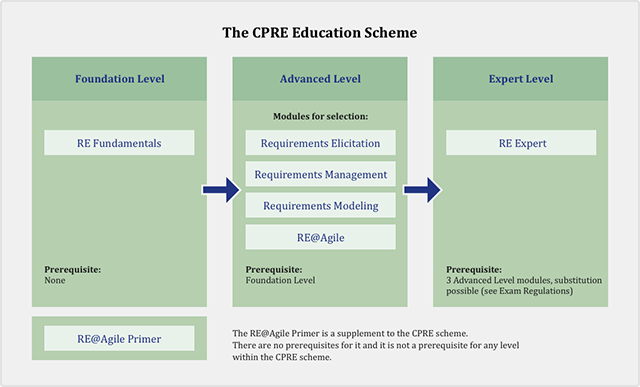
You will find a list of recommended literature for the comprehensive program on the webpage of IREB.

Syllabus:
1 Introduction and Overview of Requirements Engineering
1.1 Requirements Engineering: What kind of requirements exist? (categorizing requirements, functional and nonfunctional, constraints, assumptions)
1.2 Requirements Engineering: Why should we collect requirements?
1.3 Requirements Engineering: Where do the requirements come from? (business, user and system requirements)
1.4 Requirements Engineering: How should we collect requirements?
1.5 The Role and Tasks of a Business Analyst and a Requirements Engineer (required skills and the importance of communication)
2 Fundamental Principles of Requirements Engineering
2.1 Value-orientation
2.2 Stakeholders
2.3 Shared understanding
2.4 Context and scope
2.5 Problem – Requirement – Solution
2.6 Validation of requirements
2.7 Evolution
2.8 Innovation
2.9 Systematic and disciplined work
3 Work Products and Documentation Practices
3.1 Work Products in Requirements Engineering
3.2 Natural-Language-Based Work Products (how to write good requirements, typical mistakes)
3.3 Template-Based Work Products (sentence templates)
3.4 Model-Based Work Products
3.4.1 Why and how should we use modeling?
3.4.2 Class diagram
3.4.3 Activity diagram
3.4.4 Data flow diagram
3.4.5 State machine diagram
3.4.6 Use case diagram
3.5 Glossaries
3.6 Requirements Documents and Documentation Structures, Specification Templates
3.7 Prototypes in Requirements Engineering
3.8 Quality Criteria for Work Products and Requirements

4 Practices for Requirements Elaboration
4.1 Sources for Requirements
4.2 Elicitation of Requirements, Elicitation Techniques (Interviews, Questionnaires, Brainstorming, Document Analysis, Observation, Prototyping, etc.)
4.3 Resolving Conflicts regarding Requirements
4.4 Validation of Requirements
5 Process and Working Structure
5.1 Influencing Factors
5.2 Requirements Engineering Process Facets
5.3 Configuring a Requirements Engineering Process
6 Management Practices for Requirements
6.1 What is Requirements Management?
6.2 Life Cycle Management
6.3 Version Control
6.4 Configurations and Baselines
6.5 Attributes and Views
6.6 Traceability
6.7 Handling Change
6.8 Prioritization Techniques (Kano model, Wieger Prioritization Matrix, Ranking, etc.)

7 Tools
International Requirements Engineering Board (IREB) Certified Professional for Requirements Engineering (CPRE) Foundation Level certification examination.
Following the programme, you can take an online examination at our training centre at a pre-arranged time, or you may sit for the examination on paper at an external location, organised and previously announced by the Hungarian Testing Board. The programme fee does not include the examination fee; please contact our team for current pricing.
For additional information, visit: IREB.
Instructors


Do you have any questions about the training?

Course Administrator


I enjoyed the entire training. It was perfectly organized, and we got exactly what we were expecting. Thank you very much!
Csaba Papatyi
Széchenyi István Egyetem